Revolutionising Robotics with Synthetic Data: Advancements in AI
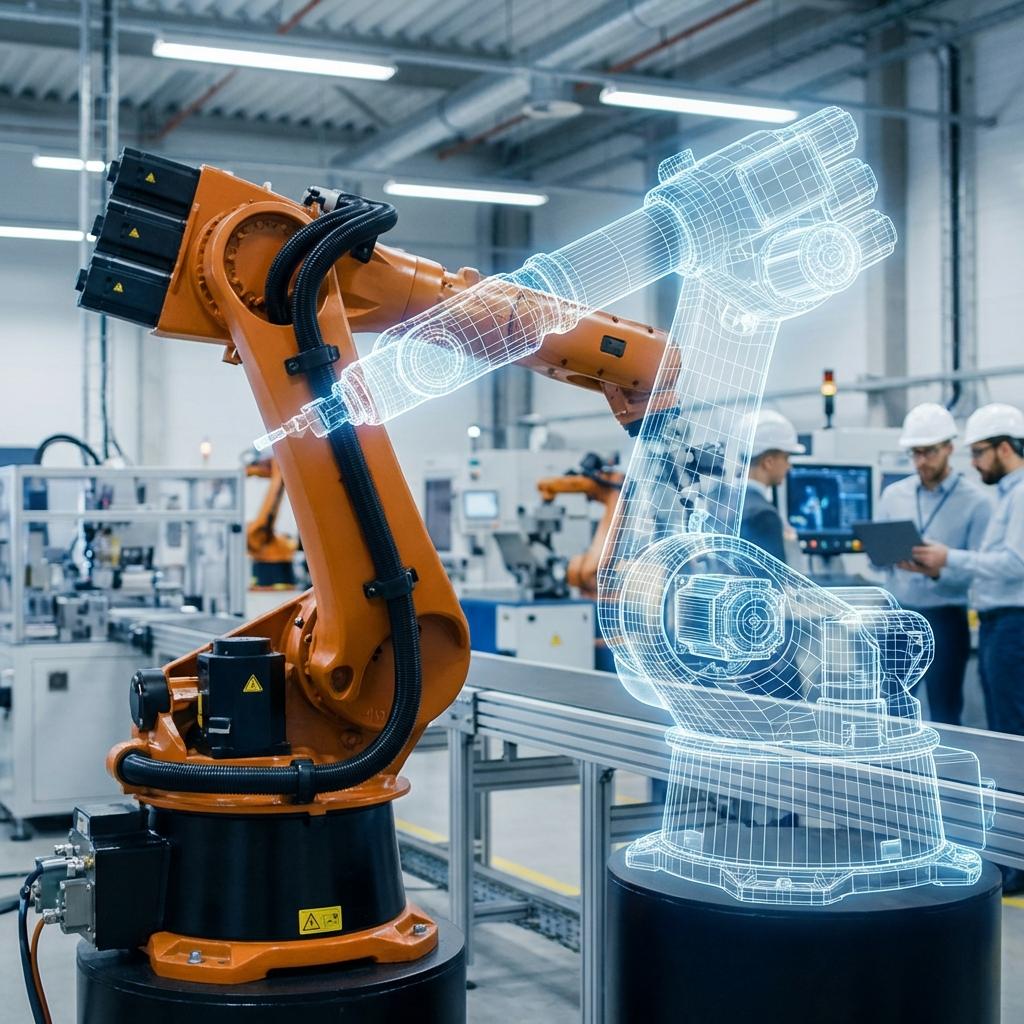
Robotics is entering a new phase. The question is no longer whether AI can perform impressive tasks in controlled environments—it clearly can. The real question is whether those capabilities can be deployed reliably, safely, and repeatedly in the physical world.
That is where most robotics programmes slow down.
Real-world data collection is expensive. Annotation is labour-intensive. Edge cases are rare. Environments change. And “it works in the lab” rarely translates into “it works on site”.
At SyntetiQ, we focus on the bottleneck that blocks real deployment: data, transferability, and measurable acceptance testing. Our Data-as-a-Service (DaaS) platform helps teams generate high-fidelity synthetic datasets and—crucially—connect them to benchmarking and deployment readiness, so robotics AI can move from simulation to production with less risk.
Why synthetic data matters in robotics
Real environments are diverse—and rarely repeat
Two facilities can look similar but behave differently in the details that matter to autonomy:
- lighting and reflections across shifts,
- clutter patterns and object variability,
- layout drift over time,
- sensor placement and calibration,
- human behaviour and operational constraints.
A model trained on a narrow slice of reality often fails under small shifts. Synthetic data enables controlled variation so models learn the range, not just the average.
Edge cases are the “real test”, but they’re hard to collect
The scenarios that cause incidents are often the least represented in real datasets:
- partial occlusions,
- rare hazards,
- unexpected objects,
- motion blur and vibration,
- sensor dropouts,
- near-miss situations.
Collecting these safely and at scale is difficult. Synthetic pipelines allow you to generate edge cases deliberately and test against them repeatedly—without waiting for them to occur in production.
Labeling is costly and inconsistent
Even when data can be collected, annotation becomes a second bottleneck:
- slow turnaround,
- high cost,
- variability across annotators and teams,
- unclear ground truth in complex scenes.
Synthetic environments provide automatic ground truth (segmentation, depth, pose, bounding boxes, metadata), which accelerates iteration and reduces label variance.
What “high-fidelity” means in practice
Synthetic data is only valuable when it is physically grounded and aligned to real deployment needs. High-fidelity means more than photorealism. It includes:
- realistic sensor effects (noise, exposure, blur),
- lighting geometry and reflections where relevant,
- physically plausible interactions and motion,
- scenario parameterisation and reproducibility.
The goal is not pretty frames. The goal is useful training experience and repeatable evaluation.
Cost reduction and faster iteration—without cutting corners
Synthetic data reduces the cost and time burden in three main ways:
1) Fewer expensive collection cycles
Real-world data collection often requires multiple site visits, reconfigurations, and repeated runs. Synthetic data shifts early iteration into simulation, so you gather only the minimal real data needed to calibrate and validate.
2) Less manual annotation
Automated ground truth significantly reduces labour and shortens feedback loops—especially for perception-heavy tasks.
3) Faster path to “good enough”
Robotics projects usually don’t fail because they can’t improve accuracy by 1%. They fail because it takes too long to get from prototype to deployable behaviour.
Synthetic pipelines compress iteration cycles from weeks/months to days—particularly in early pilots.
Where synthetic data delivers the biggest gains
Navigation
Robots must cope with changing layouts, occlusions, and environmental drift. Synthetic data supports robust scenario coverage, including rare obstacles and difficult lighting.
Manipulation
Pick-and-place and material handling depend on object variety, contact dynamics, occlusions, and clutter. Synthetic generation can systematically cover the combinations that are hard to capture in the real world.
Perception
Perception failures are common sources of operational risk. Synthetic datasets can fill missing conditions (glare, low light, reflective packaging, motion blur) and produce consistent labels to speed training.
Beyond data: the missing ingredient is benchmarking
Many organisations adopt synthetic data but still struggle to deploy. The reason is simple:
Data is not a deliverable. Deployable performance is.
To bridge the simulation-to-real gap, synthetic data must be coupled with:
- a benchmark protocol (what scenarios were tested and why),
- measurable performance metrics,
- robustness testing under domain shifts,
- safety envelope validation under constraints,
- evidence logs that support acceptance testing.
This turns a model into something operations teams can trust—and procurement teams can justify.
How SyntetiQ bridges the gap from simulation to deployment
SyntetiQ’s approach is built to support real-world deployment, not just training runs. Our DaaS platform helps teams:
- generate mission- and site-specific synthetic datasets,
- produce consistent ground truth and metadata,
- iterate quickly through scenario suites and edge cases,
- validate against benchmarks designed for acceptance,
- move toward deployment readiness with measurable evidence.
This is how robotics AI becomes safer, more reliable, and faster to scale.
Conclusion
Robotics is constrained by real-world data: it’s expensive, slow to label, and rarely contains the edge cases that define safety and reliability. Synthetic data solves the coverage and iteration problem—when it is high-fidelity, physically grounded, and linked to benchmarking.
SyntetiQ’s DaaS platform is designed to do exactly that: bridge the gap between simulation and real-world application, enabling safer, smarter, and more reliable AI-powered robotics.
If your robotics programme is stuck between promising demos and production deployment, the fastest way forward is to focus on a structured pilot: define the task, generate targeted scenario coverage, benchmark against acceptance criteria, and deliver evidence that can be deployed and monitored.