From Minimal Input to a Deployable AI Model in Hours
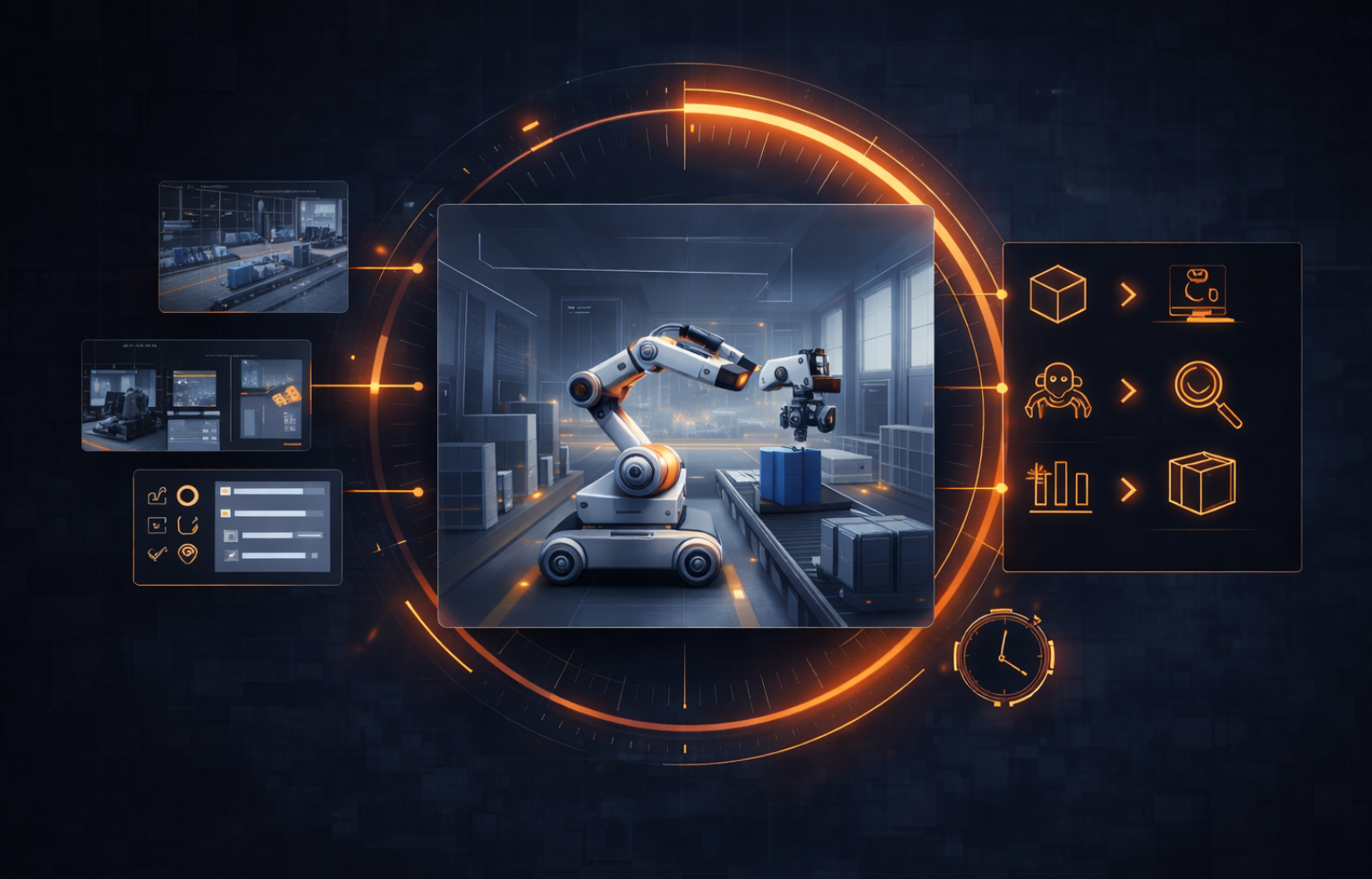
Modern AI is not limited by algorithms. It is limited by time-to-data and time-to-deployment.
In many real-world projects—robotics, inspection, autonomy, industrial perception—the slowest steps are predictable: collecting data, labelling it, reproducing experiments, and validating safety before anything touches production hardware. Meanwhile, stakeholders want results quickly and teams need a measurable pathway from “prototype” to “deployable”.
At SyntetiQ, we designed our workflow around a simple promise: with a small input from the client, we can deliver a ready-to-use AI model in hours—along with the artefacts needed to trust and integrate it.
What “small input” actually means
You don’t need months of recordings to start. For many tasks, we can begin with:
- Short videos/images of the environment and task area
- CAD/BIM or a 3D scan / point cloud (if available, but not always required)
- Operating constraints: safety zones, speed/force limits, “must not happen” rules
- Success criteria: a small set of KPIs (accuracy, cycle time, false positives, constraint violations)
This is enough to build a trainable baseline and generate meaningful scenario coverage.
Why hours—not months—is realistic
Two platform capabilities make this possible:
1) Synthetic experience at scale
Instead of waiting for real-world edge cases to occur, we generate controlled variations and rare scenarios quickly—so the model learns the conditions that actually break deployments.
2) Automated pipelines for dataset → model → validation
When data generation and training are integrated, iteration becomes fast: datasets and models can be produced in hours rather than weeks, with repeatability built in.
What you receive (the “deliverables-first” view)
A “model file” alone is not a deployment. For production teams, the deliverable must include evidence and rollout tooling.
A typical fast-turnaround delivery includes:
- A task-specific model (for the agreed input modality: vision/perception, detection, classification, etc.)
- A benchmark snapshot (illustrative acceptance testing: performance + robustness checks)
- A minimal deployment pack (integration notes, versioning, recommended monitoring signals)
For larger pilots, this expands into full evidence logs and rollback planning—but even the fast model delivery is designed to fit into an engineering workflow.
Why this is also cheaper
Real-world collection and manual labelling are expensive. Synthetic-first workflows cut cost by reducing:
- repeated site collection cycles
- long annotation backlogs
- late discovery of failure modes
In practice, synthetic data can reduce data collection/annotation cost dramatically (often cited as “up to ~80–90%” depending on task and pipeline).
Where this approach works best
Fast delivery with minimal input is especially effective for:
- perception tasks (detection/segmentation/classification)
- inspection workflows where edge cases are rare but critical
- industrial environments with repeatable geometry + controlled constraints
- EO / satellite analytics where labelled data is limited or costly
The critical disclaimer (and why it builds trust)
“Model in hours” depends on scope. The fastest track is best suited to a tightly defined task with clear KPIs and an agreed input format. Complex multi-skill autonomy or full on-robot integration will take longer—and should.
What matters is that the first usable artefact arrives fast, and then improves through measurable iterations.
Want to test fit?
If you can share:
- a short task description,
- 10–30 minutes of video/images (or equivalent), and
- your constraints and KPIs,
- we can propose the fastest path to a deployable model and show what “evidence-based delivery” looks like.
Apply: syntetiq.com/apply