AI Agent in Digital Twin for Training
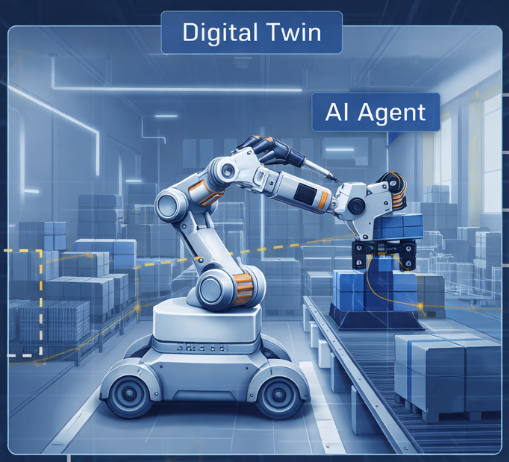
AI agents are moving from software-only environments into the physical world: robots in warehouses, inspection systems in infrastructure, autonomous devices in complex operational settings. The promise is clear—adaptive behaviour without endless manual tuning.
The reality is harder.
Physical environments are uncertain, safety constraints are real, and collecting the “right” data is expensive. That is why the next wave of real-world AI will increasingly rely on AI agents trained inside digital twins.
A digital twin is not just a 3D scene. It is a trainable, physics-aware environment where agents can explore, fail safely, and learn faster than they can in the real world—while producing measurable benchmarks and evidence logs for acceptance testing.
Why AI agents need digital twins
1) The real world is costly to learn from
Training in production environments is slow and expensive:
- collecting data requires hardware time and operational coordination,
- dangerous edge cases are difficult (or unethical) to capture,
- iteration cycles are measured in weeks, not hours.
Digital twins shift early learning and iteration off-site. You can generate scenario coverage on demand instead of waiting for real conditions to occur.
2) Safety constraints cannot be an afterthought
Real-world AI systems must comply with constraints such as:
- keep-out zones,
- speed/force limits,
- human presence rules,
- collision and proximity thresholds.
If constraints are not integrated into training and evaluation, teams end up “patching” behaviour late in the process. Digital twins enable constraint-aware training and repeatable safety-envelope validation from the beginning.
3) Agents need repeatable acceptance criteria
Most agent training failures in the field come down to measurement:
- What exactly counts as success?
- Under which scenario coverage?
- What does “safe enough” mean?
- How do we detect degradation and roll back?
Digital twins make evaluation repeatable. You can define a benchmark protocol once and run it consistently across iterations, sites, and versions.
From site inputs to a trainable twin
A strong digital twin for training does not require perfect replication of every detail. It requires faithful modelling of what drives behaviour and fast iteration.
Typical site inputs include:
- CAD/BIM or facility layout (if available),
- 3D scans / point clouds (optional but valuable),
- short video walkthroughs and images,
- robot specs (kinematics, sensors, payload limits),
- operating constraints (safety zones, rules, KPI targets).
From these inputs, the twin becomes a training arena: the agent can practise tasks under realistic conditions before touching physical hardware.
The training loop: simulate, score, improve
A robust agent training loop in a digital twin has four core stages.
1) Scenario generation
Create diverse training episodes that reflect operational reality:
- baseline scenarios (typical workflows),
- domain shifts (lighting, clutter, geometry drift),
- rare failures and edge cases,
- disturbances (sensor noise, occlusions, timing variance).
The key is intentional coverage: not “more data”, but “the right coverage”.
2) Agent training
Train the agent inside the twin using appropriate methods:
- reinforcement learning,
- imitation learning,
- policy optimisation,
- hybrid approaches for stability and speed.
The twin provides the controlled environment needed for parallel training and systematic exploration.
3) Benchmarking (measurable KPIs)
Evaluate the agent against agreed acceptance criteria, typically across:
- success rate (task completion),
- cycle time (P50/P95),
- constraint violations (safety envelope),
- failure mode breakdown under stress conditions.
This is where the training loop becomes enterprise-ready: results become reportable, auditable, and comparable across versions.
4) Transfer validation (reality-gap checks)
No twin is perfect. The goal is to manage the reality gap explicitly:
- run targeted real-world checks,
- compare performance in the twin vs. on hardware,
- update twin parameters and scenario suite,
- repeat until performance stabilises within thresholds.
This turns sim-to-real transfer from “hope” into a measurable gap.
What makes a good digital twin for agent training
Not all digital twins are equal. For agent training, quality is defined by what affects behaviour and transferability.
Physical fidelity
- accurate geometry where it impacts motion and contact,
- realistic kinematics and robot constraints,
- correct modelling of interaction boundaries.
Sensor realism
- calibrated noise models for cameras, LiDAR, depth sensors,
- motion blur and exposure effects (where relevant),
- occlusion behaviour consistent with real viewpoints.
Operational rules and constraints
- safety zones and keep-out areas,
- speed/force limits and approach constraints,
- interaction constraints (humans, equipment, workflow rules).
Scalability and speed
- ability to generate thousands of episodes quickly,
- efficient parallel simulation,
- reproducible versions and configuration control.
A twin that cannot iterate fast becomes a bottleneck rather than a solution.
Benefits for teams building real-world AI
Training AI agents inside digital twins delivers practical advantages.
Reduce data collection and labeling costs
Synthetic experience reduces reliance on heavy real-world collection cycles and manual annotation—especially when ground truth can be generated automatically.
Catch edge cases before deployment
You can surface failure modes early—before they cause downtime or safety incidents in the field.
Ship skills faster with measurable KPIs
A benchmark-first pipeline produces outputs that operations and engineering teams can trust: KPI tables, scenario coverage definitions, evidence logs, and readiness gates.
Enable continuous improvement as environments evolve
Facilities and workflows change. Digital twins allow continuous iteration:
- update the twin,
- retrain or fine-tune,
- re-run benchmarks,
- deploy safely with monitoring and rollback.
This supports scalable multi-site rollouts.
Where this is heading
AI agents in digital twins are shifting robotics and automation from slow, manual tuning to rapid, evidence-driven iteration. As digital twins become more accessible—and more specialised to specific tasks—agent training becomes safer, faster, and far more scalable.
The organisations that win will be those who build a repeatable pipeline:
site inputs → trainable twin → agent training → benchmarks → safe deployment.
That is the path from research capability to production autonomy.
If you want to explore a pilot, the fastest starting point is to define:
- the task,
- the constraints,
- the KPIs that define success,
- and the scenario coverage you need to trust.
Once those are clear, training in a digital twin becomes an engineering process rather than an experiment.