Accelerating AI in Space: A New Frontier with Synthetic Data
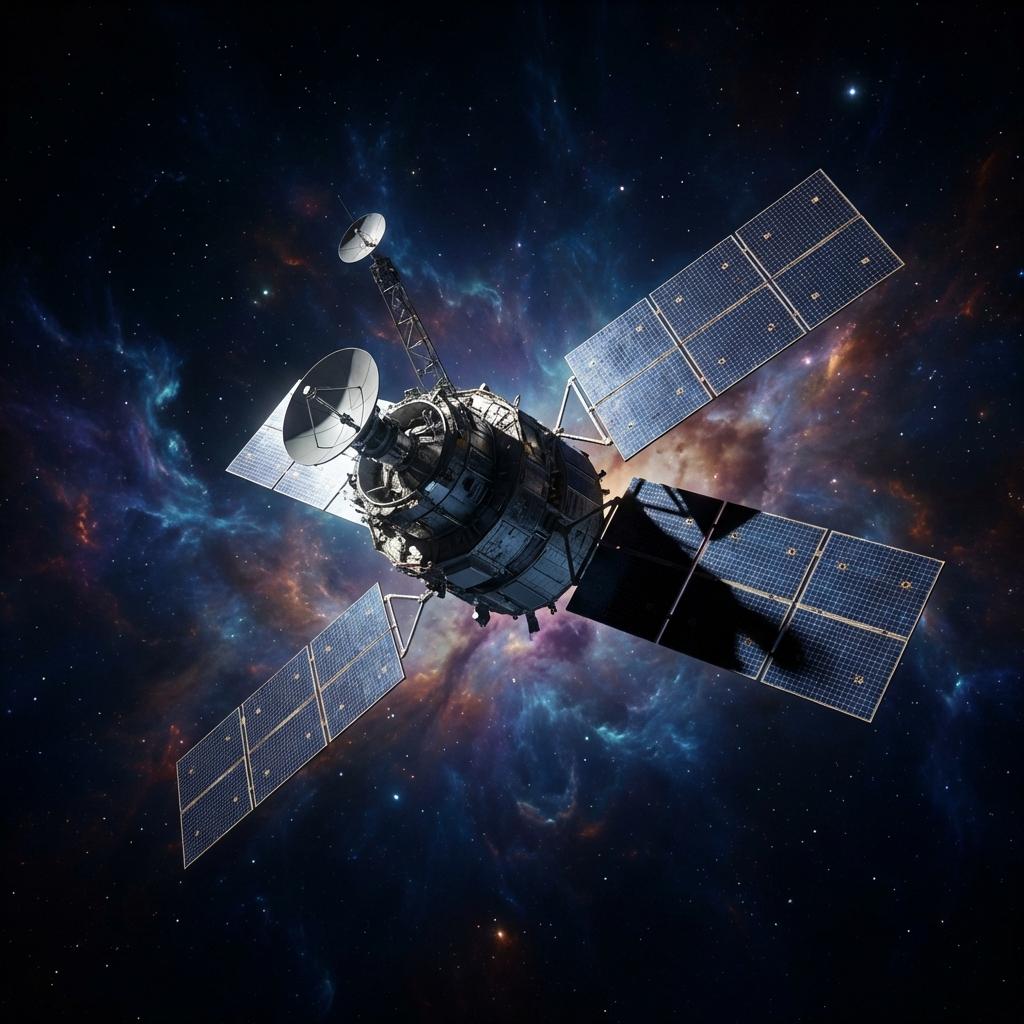
The space industry is evolving at an extraordinary pace—from large satellite constellations to increasingly ambitious missions. At the heart of this shift sits AI: onboard autonomy, resilient navigation, automated operations, and scalable Earth observation analytics.
Yet there is a persistent constraint that slows adoption across both commercial and public-sector programmes:
high-quality, domain-specific data is scarce, expensive, and often sensitive.
Synthetic data is not a shortcut. Used properly, it is a practical path to train, test, and validate AI systems when real-world space data is limited, costly to label, or restricted.
The space data problem is fundamentally different
1) Space conditions are hard to capture at scale
Many failure modes in space are rare—or impossible to gather on demand:
- extreme illumination changes and harsh shadows
- specular reflections and low-texture surfaces
- radiation effects and sensor artefacts
- unusual attitudes, tumbling objects, and occlusions
- long-tail events in orbital mechanics and operations
Real mission data is invaluable, but it rarely provides broad and repeatable coverage of edge conditions.
2) Annotation is expensive and slow
Even when data exists (e.g., imagery, telemetry, onboard video), annotation and ground-truthing can be difficult:
- labels are often ambiguous without precise geometry and timing
- truth data may require expert interpretation
- pipelines are fragmented across teams and contractors
3) Security and confidentiality constraints are real
For many space programmes—especially those with dual-use, defence, or critical infrastructure ties—data can be sensitive. Sharing raw datasets with external parties can be constrained by policy, contractual terms, or operational risk. Synthetic datasets offer an alternative path to collaboration without exposing original sensitive data.
Our approach: synthetic data tailored for space
At SyntetiQ, we focus on physically grounded synthetic datasets designed to reflect real-world conditions in orbit and on extraterrestrial surfaces. The goal is not to generate “pretty images”—it is to generate useful training and validation data that supports measurable performance and repeatable benchmarking.
Key principles:
- Physics-aware rendering and sensors (illumination geometry, noise models, sensor effects)
- Scenario variation at scale (domain randomisation and targeted edge cases)
- Ground truth generation (metadata, geometry, segmentation, pose/orbit parameters)
- Benchmark-first delivery (datasets aligned to evaluation protocols, not just training)
Where synthetic data delivers the most value in space
1) Satellite operations and proximity scenarios
AI is increasingly used to support:
- relative navigation and rendezvous support
- collision avoidance reasoning under uncertainty
- automated inspection and formation operations
Synthetic data enables repeatable coverage of:
- changing lighting angles and albedo
- object shapes, materials, and reflective properties
- dynamic relative motion profiles
- sensor conditions (blur, glare, partial occlusions)
2) Earth observation analytics
Earth observation models often struggle because:
- the environment changes (seasons, atmosphere, haze)
- labels are incomplete or expensive
- edge cases (disaster conditions) are rare but critical
Synthetic data can support:
- controlled scenario variation and augmentation
- balanced datasets for underrepresented conditions
- accelerated iteration without repeatedly waiting for new real-world collections
3) Spacecraft health and telemetry intelligence
Predictive maintenance and anomaly detection can benefit from synthetic or simulated telemetry streams:
- failure injection scenarios (rare faults)
- structured variations in operational patterns
- consistent labelled examples for model training and evaluation
The payoff is faster model development and stronger generalisation under uncertainty.
Why synthetic data works — when implemented correctly
Speed of iteration
Traditional space datasets can take months to assemble and label. Synthetic data enables rapid cycles:
- define the scenario → generate variants → train → evaluate → iterate
This compresses time-to-insight and reduces “stall time” between experiments.
Massive scalability
Synthetic pipelines can generate millions of unique scenarios:
- targeted edge cases
- parameter sweeps (lighting, angles, materials, motion profiles)
- coverage across mission-relevant regimes
Scale matters because AI performance is often gated by long-tail conditions.
Security by design
For programmes with sensitive constraints, synthetic data can:
- reduce the need to expose raw operational datasets
- support collaboration and benchmarking without releasing originals
- separate “model training resources” from “mission data exposure”
Reduced bias through controlled coverage
Real datasets can be skewed toward what is easy to collect. Synthetic data allows you to design coverage intentionally:
- underrepresented conditions
- rare or risky scenarios
- balanced distributions that improve generalisation
The real differentiator: measurable benchmarks, not just datasets
In space (as in robotics), the critical question is not “do we have more data?” but:
Can we prove performance and robustness under mission-relevant conditions?
High-quality synthetic data should arrive with:
- a defined scenario suite (what was generated and why)
- explicit ground truth
- evaluation protocols and success thresholds
- evidence logs that support repeatability and auditability
This is how synthetic data becomes an engineering tool rather than a marketing term.
Closing thought
Space missions don’t fail because of ambition. They fail when risk is not managed systematically. AI in space is no different: adoption depends on measurable evidence, reliable validation pathways, and controlled iteration.
Synthetic data provides a practical route to build those pathways—faster, safer, and at scale—when real-world datasets alone cannot carry the load.
If you’re exploring a pilot use case (operations, EO analytics, or telemetry intelligence), start by defining a benchmark suite and the acceptance criteria you will trust. Everything else becomes easier once “success” is measurable.